Does Solar Add Measurable Value to Homes?
Posted: October 16, 2026 by John McClelland
Does Solar Add Measurable Value to Homes?
October 2026 · Las Vegas market research
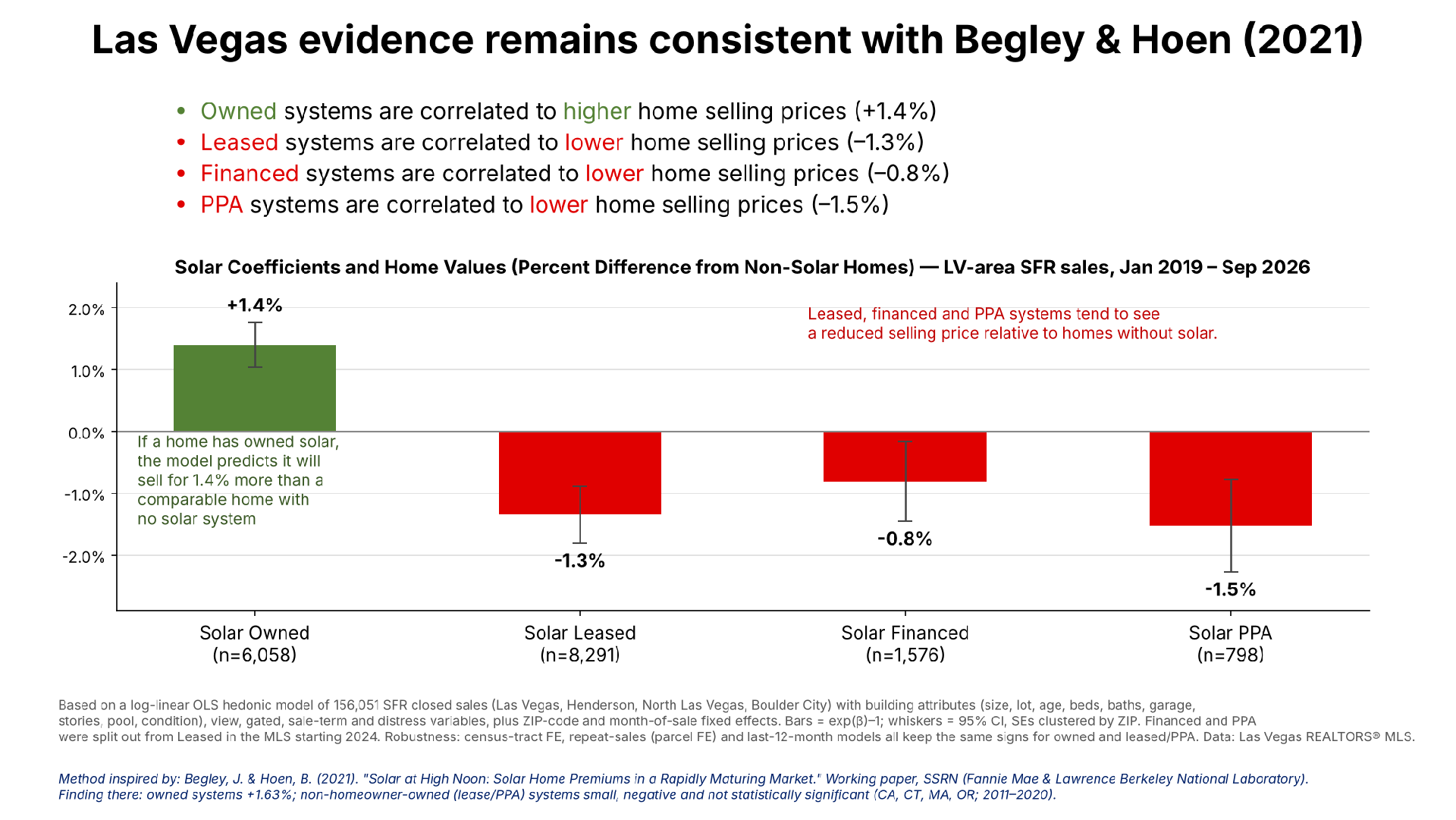
A natural question in sunny Las Vegas. Solar adoption has grown: this year, over 17% of single-family homes that sold through the MLS had solar, up from around 11% in 2022. But how does this break down in terms of value? For one, solar is only a positive influence on price if it is owned. In our analysis of more than 156,000 Las Vegas–area single-family sales from January 2019 through September 2026, homes with owned solar sold for about 1.4% more than comparable homes without solar. Homes with leased, financed or PPA systems sold for roughly 1% to 1.5% less.
That pattern is consistent with the largest national study on the subject, Begley & Hoen (2021). Solar panels on the roof are not what buyers pay for. They pay for the savings, and for not taking on someone else's contract.
On a $475,000 home, a 1.4% premium is roughly $6,600. A 1.3% discount is roughly $6,200 in the other direction. The swing between those two outcomes can be more than $12,000 on the same house, depending on who owns the panels.
Four ways to have solar on your roof
Who owns the panels, and who keeps paying for them, is what separates a premium from a discount. The Las Vegas MLS tracks four ownership types.
| Type | Who owns the panels | What the homeowner pays | What happens at sale |
|---|---|---|---|
| Owned | The homeowner, outright | Nothing ongoing | Transfers with the house like any other fixture |
| Financed (solar loan) | The homeowner | Monthly loan payments, often 10–25 years | The loan is usually paid off from the seller's proceeds; some lenders allow assumption |
| Leased | A third-party solar company | A fixed monthly rent, often with a yearly escalator | The buyer must qualify for and assume the lease, or the seller buys it out |
| PPA (power purchase agreement) | A third-party solar company | A price per kWh the panels produce, often with a yearly escalator | Same as a lease: assumed by the buyer or bought out |
What is a PPA? Under a power purchase agreement, a solar company installs and owns the system on your roof. You agree to buy the electricity it produces at a set price per kilowatt-hour, usually below the utility's rate when you sign. You don't own the equipment, and your payment rises and falls with how much the panels produce.
How leases work. A lease is similar, except you pay a flat monthly amount regardless of production. Most run 20 to 25 years. Many include an escalator that raises the payment each year. A prepaid lease is paid up front, often by a builder, but the panels still belong to the solar company.
How financed systems work. With a solar loan, you own the panels but owe a lender. The lender often records a UCC-1 fixture filing in the county records. That filing has to be cleared or handled before closing, which can slow a sale.
The practical difference: a buyer of an owned system gets free power-producing equipment. A buyer of a leased or PPA system inherits a 20-year contract with a company they didn't choose. That contract may cost more than the electricity it replaces.
What the Las Vegas data shows
Owned solar carries a premium, and every third-party arrangement carries a discount. That holds across the full period, the most recent 12 months, and a repeat-sales test comparing the same homes before and after.
| Solar type | Homes with it | Price vs. no solar, Jan 2019–Sep 2026 | Last 12 months (Oct 2025–Sep 2026) | Same home, sold twice |
|---|---|---|---|---|
| Owned | 6,058 | +1.4% | +1.6% | +0.7% |
| Leased | 8,291 | –1.3% | –1.9% | –1.0% |
| Financed | 1,576 | –0.8% | –0.2% (not significant) | –1.3% |
| PPA | 798 | –1.5% | –2.0% | –1.8% |
Three things stand out:
- The gap is widening. In the last 12 months, owned solar earned +1.6% and leased solar –1.9%, a spread of about 3.5 points.
- Financed systems sit in between. The buyer usually gets the panels free and clear once the seller's loan is paid at closing. Recent sales show almost no discount.
- The owned premium is real but modest. When we compare the same house before and after solar, the premium shrinks to +0.7%. Part of the headline premium reflects the kind of homes and neighborhoods where owners install solar.
One note on the data: the MLS only began separating Financed and PPA from Leased in 2024. Before that, most third-party systems were recorded as Leased.
What the national research says
Our approach is modeled on Begley & Hoen (2021), "Solar at High Noon: Solar Home Premiums in a Rapidly Maturing Market". It is a working paper by Jaclene Begley of Fannie Mae and Ben Hoen of Lawrence Berkeley National Laboratory. They matched about 555,000 appraisals in California, Connecticut, Massachusetts and Oregon from 2011 to 2020 against a national database of solar installations.
Their findings line up with Las Vegas on the main point:
| Study | Owned solar | Leased / PPA solar |
|---|---|---|
| Begley & Hoen (2021), 4 states, 2011–2020 | +1.63% | Slightly negative, not statistically significant |
| Hoen, Rand & Adomatis (2017), "Leasing Into the Sun", California, 2011–2013 | Premium (prior studies) | No significant premium |
| Hoen et al. (2015), "Selling Into the Sun", 8 states, 2002–2013 | About $15,000, or $4.18 per watt | Not studied separately |
| This analysis, Las Vegas SFR, 2019–2026 | +1.4% | –1.3% to –1.5% |
Begley and Hoen also found the premium per kilowatt fell from 1.23% in 2011 to under 0.4% after 2016 as solar became common. They point to a key reason leases don't add value: appraisers don't count a third-party system as part of the house, and the lease payments eat into the savings.
Where Las Vegas differs is in degree. Nationally, leased and PPA systems were roughly neutral. Here, they come with a measurable discount.
Why cheap power changes the math
Las Vegas electricity is cheap by national standards, in line with other Mountain West cities and far below California. That is likely why third-party solar fares worse here than in the national studies, which were dominated by California homes.
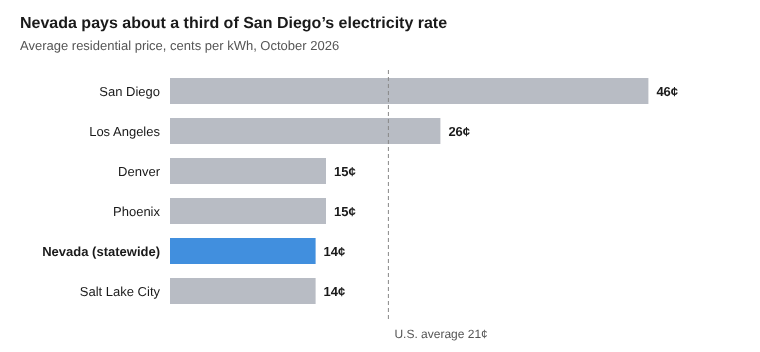
Source: EnergySage local electricity-cost data, October 2026, based on bills shared by EnergySage users. Nevada is the statewide figure; EnergySage does not publish a separate Las Vegas rate.
A solar system is worth what it saves. In San Diego, where power costs about 46¢ per kWh, even a leased system can save money after the lease payment. In Nevada, at about 14¢, the gap between a lease payment and the utility bill it replaces is much thinner. A buyer looking at a $120 monthly lease with a yearly escalator may decide it barely beats NV Energy, or doesn't.
An owned system has no payment to subtract, so all of its savings go to the homeowner. That is the simplest explanation for why ownership type matters more in Las Vegas than in California.
Nevada's rules add to this. In September 2025, the Public Utilities Commission of Nevada approved two changes:
- 15-minute netting replaced monthly netting. Exported power now only offsets usage in the same 15-minute window.
- A daily demand charge for residential customers is scheduled to start January 1, 2027, after regulators pushed it back from April 2026. Solar credits cannot offset it.
Under the new rules, rooftop solar customers pay about $12 more a month on average, according to state regulators and NV Energy. These rules shrink the savings from every system. For a lease or PPA, that means less room left over after the payment.
Las Vegas rates have also risen more slowly than the nation's. Nevada's average residential price went from about 11.9¢ around 2018 to about 13.1¢ in October 2026. Over a similar period, the U.S. city average rose from 13.5¢ (January 2019) to 19.6¢ (September 2026). Slow rate growth means a lease escalator can catch up with the utility bill faster.
What this means if you're buying or selling
If you're selling a home with solar:
- Gather the paperwork early: the purchase contract, lease or PPA agreement, monthly payment, escalator, remaining term and transfer process.
- Disclose the ownership type accurately.
- If you have a lease, ask the solar company for a buyout quote. On a strong offer, paying it off may cost less than the price discount.
- If you have a solar loan, confirm the payoff amount and whether a UCC-1 filing needs to be released.
If you're buying a home with solar:
- Ask whether the system is owned, financed, leased or a PPA. Don't rely on the listing alone; ask for the contract.
- For a lease or PPA, compare the monthly payment and escalator with your expected NV Energy bill. Factor in the 2025 netting and demand-charge changes.
- Budget time for the solar company's credit check and transfer paperwork, which can take weeks.
If you're buying new construction: some builders now include solar as standard. Beazer Homes, for example, includes solar in many Las Vegas communities. Ask whether the system is owned outright, prepaid-leased or financed, since that determines what it's worth at resale.
How we measured it
We used a hedonic pricing model, the standard method appraisers and economists use to separate the value of one feature from everything else about a home. The data covers 156,051 closed single-family sales in Las Vegas, Henderson, North Las Vegas and Boulder City from the Las Vegas REALTORS® MLS, January 2019 through September 2026.
The model compares the log of each sale price against the home's size, lot, age, bedrooms, bathrooms, garage, stories, pool, condition, views, gated community, sale terms and distress status. It also controls for ZIP code and the month of sale, so neighborhood and market timing don't drive the result. We checked the results with census-tract controls, a repeat-sales model on homes that sold more than once, and a last-12-months sample. The direction of every result held.
These are associations, not proof of cause. A leased-solar home could differ in ways the MLS doesn't record. The consistent pattern across tests, and its match with national research, makes ownership type the most likely explanation.
Sources
- Begley, J. & Hoen, B. (2021). "Solar at High Noon: Solar Home Premiums in a Rapidly Maturing Market." Working paper, SSRN (Fannie Mae & Lawrence Berkeley National Laboratory).
- Hoen, B., Rand, J. & Adomatis, S. (2017). "Leasing Into the Sun: A Mixed Method Analysis of Transactions of Homes with Third Party Owned Solar." Lawrence Berkeley National Laboratory.
- Hoen, B. et al. (2015). "Selling Into the Sun: Price Premium Analysis of a Multi-State Dataset of Residential Home Sales with and without Photovoltaic Energy Systems." Lawrence Berkeley National Laboratory.
- EnergySage electricity costs, October 2026: San Diego, Los Angeles, Denver, Salt Lake City, Nevada
- FRED: U.S. city average electricity price (BLS)
- EnergySage: Phoenix electricity rates
- ElectricChoice: Nevada electricity prices
- NV Energy: 2018 average retail price brochure
- Solar Power World: Nevada PUC approves 15-minute netting
- Las Vegas Review-Journal: demand charge petition denied
- KTNV: North Las Vegas leased-solar disclosure dispute
- FOX5 Las Vegas: daily demand billing starts January 1, 2027
